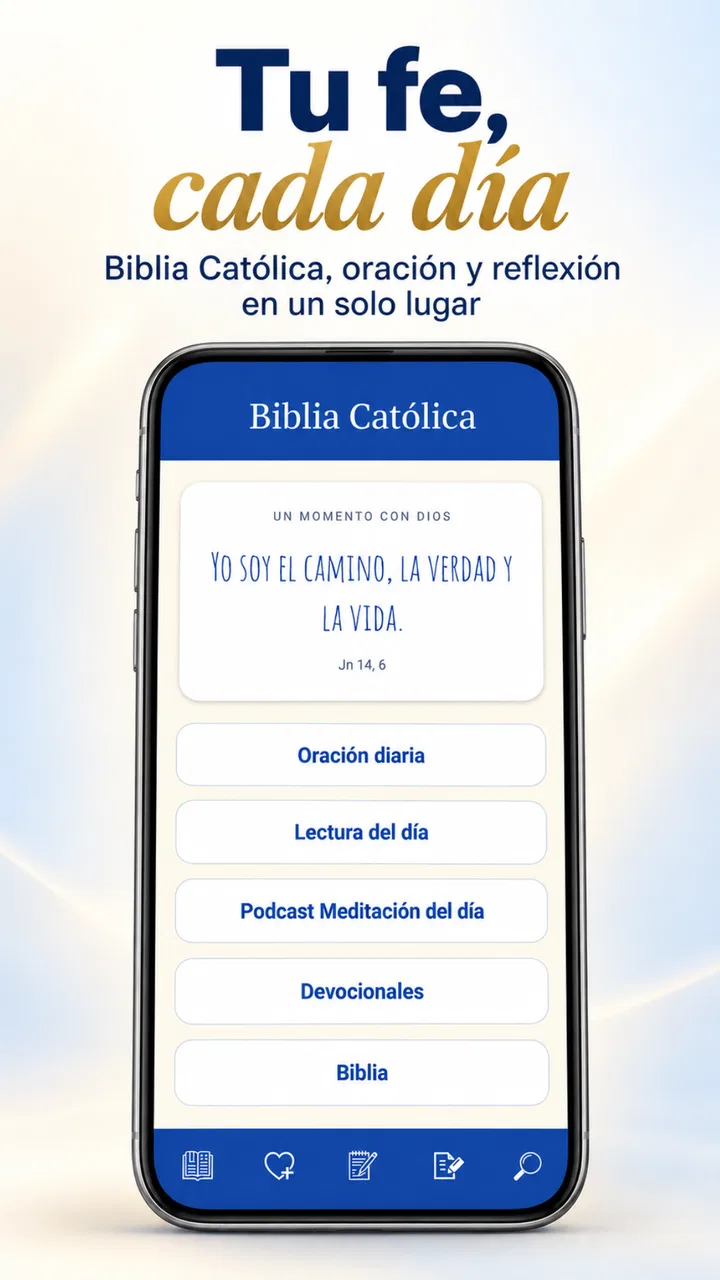
Biblia Católica en español
- 4.8
- Rating
- 5.00M
- Installs
- Free
- Price

 Analysis by App-foxy
Reading the Bible on a phone can be convenient, but convenience is not the only thing I look for in a religious reference app. I also want to know whether the experience feels calm, whether I can control how I use it, and whether the app makes its purpose clear instead of distracting me with unnecessary extras. Biblia Católica en español takes a straightforward approach: it brings the Catholic Bible in Spanish to Android devices and adds audio for people who prefer listening.
After spending time with it, I see the app as a practical companion for personal reading, prayer, study, and quiet listening. It is not trying to replace a printed Bible in every situation, nor does it offer the broad research environment of a specialized study platform. Its value is simpler and more focused. If Spanish is your preferred language and you want Catholic Scripture available without paying, this app deserves a close look.
What the app feels like in everyday use
The first impression is one of accessibility. The app belongs to the Books & Reference category, which fits its role well: it is primarily a digital reference and reading tool rather than a social network or entertainment product. The developer is BuenaOnda APP, and the application has built a substantial audience, with more than one million installs and an average rating of 4.8 from roughly one hundred six thousand ratings.
You May Also Like

 Blood Strike: 2.5 Anniversary
Blood Strike’s Loadouts Turn Every Drop Into a Tactical Gamble
A close look at Blood Strike’s custom loadouts: how fast access to signature weapons reshapes its battle royale rhythm, rewards preparation, and narrows the gap between fights.

 Pandora - Music & Podcasts
Pandora’s Music Is Easy to Start, but Harder to Recover
Pandora’s strength is its low-effort path from a seed to a station. Its weak spot is how much confidence it asks you to place in connection, setup, and quiet recovery.

 8 Ball Pool
 Is Built on Rivalries, Rematches, and Routine
A close look at the rivalries, rematches, shared routines, and unanswered safety questions that turn a quick pool match into a persistent mobile community.

 Samsung Music
’s Quiet Strength Is Playing What You Already Own
Its reach comes less from spectacle than from dependable access to a personal library. That simplicity is both the app’s strongest retention engine and its ceiling.

 AccuWeather: Weather Radar
AccuWeather Review: A Quick, Clear Forecast for Everyday Decisions
For everyday plans, the best forecast is the one you can understand quickly. AccuWeather makes rain timing, radar, and local conditions easy to act on, with a few trade-offs.

 Hill Climb Racing
Why Hill Climb Racing Still Turns Crashes Into One More Run
A tiny car, a bumpy hill and one more upgrade: Hill Climb Racing keeps resurfacing because its simple chaos makes every near-miss feel personal.
More From Our News Desk



Those figures do not automatically prove that every reader will enjoy it, but they do suggest that the basic idea works for many people. I can understand the appeal. A phone is usually nearby, and having Scripture ready when I am commuting, waiting for an appointment, or trying to establish a short evening reading habit removes a lot of friction. I do not need to carry a separate book, remember where I left off physically, or search the web every time I want to read a passage.
The app is free, and its Everyone age rating makes it approachable for households with different users. That does not mean every child will find the interface equally comfortable, but the subject matter and general purpose are suitable for broad family use. The current version is 35.2, and it runs on Android 8.0 or later, so it is not limited to only the newest phones.
One useful distinction is that this is a Catholic Bible experience, not simply a generic Spanish Bible reader. That matters to readers who want their digital reference to match the Catholic canon they are accustomed to using. Someone choosing an app only because it has the word “Bible” in its name may overlook that difference, while someone already looking for Catholic Scripture will likely appreciate the more specific focus.
Audio changes the way the app fits into a routine
The audio option is the feature that most clearly expands the app beyond a basic electronic book. Reading requires attention to the screen, while listening can fit into moments when my hands and eyes are occupied. I can imagine using it during a quiet walk, while preparing breakfast, or before sleep when I do not want the brightness of a display in front of me.
Audio is also useful for readers who struggle with small text, fatigue easily, or understand a passage better when it is heard. It can turn a short break into a listening session without requiring the user to treat the phone like a study desk. At the same time, listening is not always the best option. If I need to compare verses, pause over a phrase, or check the surrounding context, reading gives me more control.
My practical advice is to treat the two modes as complementary rather than choosing one permanently. I would listen when I want continuity and use the text when I want to examine wording. That simple switch makes the app more versatile than a printed volume in some situations, although a physical Bible still feels better for extended annotation and page-to-page comparison.
Finding a passage without turning reading into a search task
A digital Bible is only helpful if it lets me reach the passage I want without making the process feel like administrative work. The most sensible workflow is to begin with the book and chapter when I already know the reference, then use the text itself for slower reading. When I only remember a phrase or theme, searching is more useful than guessing where it appears.
There is a trade-off here that is easy to miss. Search is excellent for locating a familiar expression, but it can encourage me to jump directly to isolated lines. For devotional reading, I prefer opening the surrounding chapter and reading beyond the exact result. That preserves context and reduces the risk of treating a single sentence as a complete answer to a complicated question.
For study, I would keep a notebook or separate notes app nearby. A Bible reader can make Scripture easy to access, but it does not automatically replace the discipline of recording questions, cross-references, or personal reflections. This is one of the app’s boundaries: its strength is availability, not a full academic research workflow.
Trust, controls, and responsible everyday use
When I evaluate an app that may become part of a private spiritual routine, I do not want to assume anything about invisible data practices. I focus on what I can actually see and control while using it. The most reassuring aspect of this application is its clear purpose. It presents itself as a Spanish Catholic Bible with audio, so the user can judge the product primarily by the reading and listening experience rather than by a complicated ecosystem of unrelated services.
I would still make a habit of checking the permission prompts shown by my own device during installation and use. Android displays those choices in context, and they are more useful than guessing from an app’s category. If a permission is requested, I would ask whether it makes sense for the action I am trying to perform. For example, listening to Scripture and reading text should be evaluated separately from any optional phone capability that may appear later.
This is not a reason to avoid the app; it is a sensible practice for any application. I also recommend reviewing Android’s app controls after installation, especially if the phone is shared with family members or used for sensitive personal routines. I prefer to keep only the access that matches the features I actively use, and I would revisit those choices after an update if the behavior or available options change.
Private moments deserve deliberate choices
A Bible app can be used in very personal circumstances: during prayer, while reflecting on grief, or when searching for guidance about a difficult decision. I would not treat any mobile application as a private diary simply because its subject is religious. I keep personal reflections outside the reading app unless I have deliberately checked the available controls and understand where those reflections are stored.
The same caution applies to notifications and the phone’s lock screen. If the app offers reminders or if Android displays recent activity, I would consider whether that information could be visible to someone else using the device. A reminder can support a reading habit, but a quieter setup may be preferable on a shared phone. The right choice depends on the user, and the important point is that the routine should remain under the reader’s control.
I also avoid assuming that an audio session is private merely because headphones are connected. Bluetooth devices, car systems, and shared speakers can route sound in unexpected ways. Before starting a listening session in a public or shared setting, I check the output device and volume. That is a small habit, but it prevents an otherwise peaceful feature from becoming awkward.
Where this app is stronger than common alternatives
Compared with carrying a printed Bible, the app wins on portability and immediate access. Audio is another clear advantage, and the free price removes a barrier for someone who wants to begin reading without buying a new edition. A printed book remains better for writing in margins, seeing a familiar page layout, and reading without battery concerns, so I would not describe the app as a universal replacement.
Compared with opening a general web search, the dedicated app offers a more focused environment. Searching online can lead to many translations, commentary pages, advertisements, and unrelated results. A purpose-built Bible reader keeps the central task closer at hand. The downside is that a web search may offer broader comparison tools or scholarly material, while this app is more appropriate for direct access to Catholic Scripture than for extensive source analysis.
Compared with a large study Bible platform, the appeal here is likely its lower complexity. I do not need a dashboard full of study resources to read a chapter or listen to it. That simplicity can be a strength for a beginner or for someone who wants fewer distractions. It can also feel limiting to a theology student, catechist, or serious researcher who expects extensive notes, original-language tools, linked commentary, and a more developed system for organizing research.
A realistic routine that makes the features work together
Imagine that I have a twenty-minute bus ride and want to use it well. I might begin by listening to a chapter rather than trying to read on a moving vehicle. Later, when I arrive, I could reopen the text and read the same passage more slowly, checking the lines that stood out during the audio. In the evening, I might write a brief reflection in a separate notebook instead of turning the Bible app into a storage place for sensitive thoughts.
This routine uses the app’s strongest qualities without asking it to do everything. Audio handles the first exposure, text supports closer attention, and an external note-taking method preserves flexibility. It also avoids a common mistake: assuming that a fast listening session is equivalent to careful study. The two activities serve different purposes, and recognizing that difference improves the experience.
For a family, I would use the app differently. One person could read aloud from the text while another follows along, or everyone could listen together during a short quiet period. On a child’s device, I would combine the Everyone rating with the phone’s own parental and screen-time controls. The age rating is helpful context, but it does not replace a parent’s judgment about device use, listening time, or access to other phone functions.
Limitations I noticed before recommending it
The free format is attractive, but users who expect a polished research suite may find the experience too narrow. A Bible reader is not automatically a commentary library, a theological course, or a personal knowledge-management system. If your main goal is comparing many translations, building elaborate lesson plans, or linking Scripture to extensive academic references, I would look for a more specialized alternative.
Audio also introduces practical limitations. Listening is less precise than reading when I need to revisit a particular phrase, and it depends on an environment where sound is appropriate. A noisy commute may reduce comprehension, while a quiet room may make reading more satisfying. I would not judge the audio mode by whether it replaces reading; I would judge it by whether it gives me another realistic way to stay connected with the text.
Phone reading itself can be tiring. Notifications, incoming messages, and the temptation to switch apps are always nearby. Even a focused Bible application cannot fully control the habits of the device around it. I get better results when I silence interruptions and decide in advance whether I am reading for five minutes, listening to a chapter, or studying a specific passage.
There is also a difference between convenience and depth. The app makes access easy, but easy access does not guarantee thoughtful interpretation. For difficult passages, I would consult a trusted Catholic resource or discuss the text with a knowledgeable person rather than expecting the app alone to resolve every question. That is not a criticism of its core purpose; it is a reminder to match the tool to the task.
Who should install it, and who may prefer something else
I would recommend it to Spanish-speaking Catholic readers who want a free Bible app with audio, especially those building a modest daily reading or listening habit. It is also a sensible choice for someone who travels, shares a small living space, or wants Scripture available without carrying a physical book. The broad age rating makes it easy to consider for family use, provided each household manages its own device settings thoughtfully.
I would be more cautious about recommending it as the only tool for formal study. Students, teachers, and readers who need detailed annotations or multiple scholarly resources may outgrow its focused approach. Someone who strongly prefers paper, avoids screens during prayer, or does not want audio will gain less from installing it. In those cases, a printed Catholic Bible or a more research-oriented application may be the better fit.
The developer’s long-running presence in the app’s release history and the large number of users make the product feel established enough to try, but I still prefer making decisions based on the controls visible on my own phone rather than on popularity alone. A high rating can tell me that many people find the app useful; it cannot decide whether its reading style, audio workflow, and privacy choices suit my particular routine.
My cautious verdict is positive. The best reason to choose this app is the combination of Catholic Spanish Scripture, audio access, and a free entry point, not the promise that it will replace every Bible-related resource. I would install it for convenient reading and listening, keep sensitive reflections in a space I control directly, review Android permissions and notifications, and use a separate source when I need deeper study.
In my experience, that balanced approach is where Biblia Católica en español makes the most sense. It is focused, approachable, and useful in ordinary moments, from a short morning reading to an evening listening session. If you want a simple digital Catholic Bible in Spanish and understand the limits of a phone-based reference tool, it is an easy app to recommend to a friend.
FAQs for Biblia Católica en español
01What features does Biblia Católica en español offer?
Biblia Católica en español provides a comprehensive digital version of the Catholic Bible in Spanish. It includes features like bookmarking, highlighting, and annotation to enhance your reading and study experience. The app also offers daily verses, reading plans, and offline access, making it convenient for users to engage with the scriptures anytime, anywhere.
02Is Biblia Católica en español available offline?
Yes, Biblia Católica en español offers offline access, allowing users to read the Bible without an internet connection. This feature makes it ideal for those who may not always have Wi-Fi or data access, ensuring that you can continue your spiritual journey wherever you are, without interruption.
03Does the app include any additional resources or tools?
Biblia Católica en español includes various tools to enrich your study experience. These include concordances, commentaries, and cross-references to deepen your understanding. It also provides audio versions of the scriptures for those who prefer to listen, as well as customizable reading plans to guide your study journey.
04Is there a cost associated with downloading or using the app?
Biblia Católica en español is typically available for free download with optional in-app purchases. These purchases may include ad removal, additional content, or enhanced features. Users can enjoy the core functionalities at no cost, while premium features offer an expanded experience for those interested.
05How user-friendly is Biblia Católica en español for beginners?
The app is designed with a user-friendly interface, making it accessible for beginners and experienced users alike. It offers intuitive navigation, clear fonts, and helpful guides to assist users in finding passages or utilizing features. Whether you're new to digital Bibles or a seasoned user, you'll find it easy to navigate and use.
Pros
- Comprehensive Catholic content.
- User-friendly interface.
- Offline access available.
- Daily scripture notifications.
- Bookmark and note features.
Cons
- Contains ads in free version.
- Limited language options.
- No audio Bible feature.
- Occasional app crashes.
- Requires frequent updates.

Biblia Católica en español
Gallery